Best Board Games for Tweens Aged 8 to 12
Which board games suit kids aged 8 to 12 who are ready for more?
On this page
Why Ages 8 to 12 Is a Tricky Game-Buying Window
If you've ever watched an 8-to-12-year-old roll their eyes at a "baby game" and then melt down over a complicated strategy box, you already know the problem. This age sits in an awkward bridge zone, and it makes buying the right game genuinely hard.
Here's what's actually going on:
- They've outgrown pure luck. Games decided entirely by a dice roll or a spinner feel too random and too young. Tweens want their choices to matter.
- But adult-weight strategy frustrates them. "Heavy" games (hobby shorthand for titles with lots of rules and deep planning) often overwhelm them and kill the fun fast.
- Their decision-making is genuinely developing. Games with light, meaningful choices—a few options each turn rather than dozens—keep them thinking without burning them out.
- Mixed-age households add pressure. A game needs to work when an 8-year-old and a 12-year-old play together, so nobody feels lost or bored.
- Attention spans favor shorter sessions. Most tweens stay locked in for a 20–45 minute game, while multi-hour epics tend to fizzle before the end.
So if past purchases have missed the mark, it's not you. This age band simply needs games built for the in-between. The picks below are chosen with exactly that balance in mind.
How We Chose These Games (What to Look For)
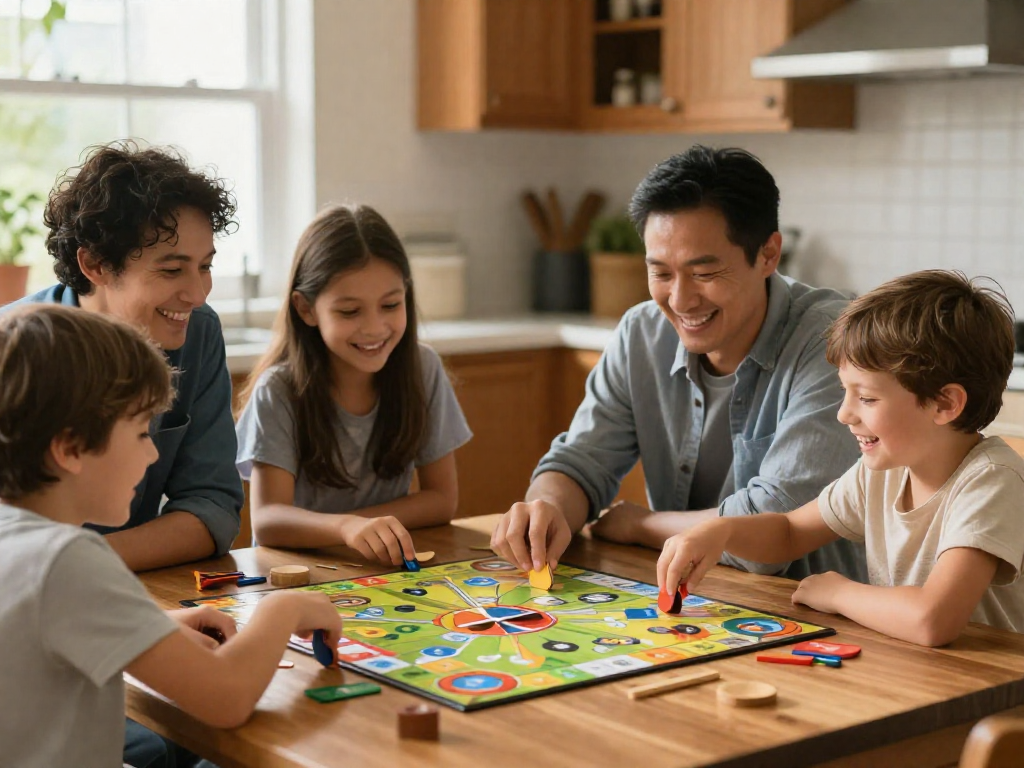
We've played all of these at our own family game nights, but the real goal of this section is to hand you a checklist you can use on any game—not just the ones below. Here's what we weighed.
- Age rating vs. real difficulty. The age printed on the box is a rough legal and safety guide, and it usually runs conservative. A "10+" game is often a great fit for a sharp 8-year-old, while some "8+" games drag for a bored 12-year-old. Read the actual rules complexity, not just the number.
- Player count match. Check the "best at" count, not just the allowed range. A game that technically plays 2–6 may shine only at 4. If you're a family of three, prioritize games that feel complete at three players.
- Game length and setup effort. A 90-minute game with a 15-minute setup is a hard sell on a school night. We note play time and how fiddly the box is to get on (and off) the table.
- Replayability and room to grow. The best picks stay fun across dozens of plays and reveal new depth as your child matures—so they don't get shelved in a month.
- Reading load and rules clarity. For kids to play on their own, the rulebook (the booklet explaining how to play) needs plain language and clean reference cards. Heavy reading means an adult has to run every turn.
Score a game against these five points and you'll rarely be disappointed.
Best Overall Board Games for Tweens
These three picks are our crowd-pleasers—the games that pull in 8-year-olds and 12-year-olds (plus the grown-ups) without anyone getting bored or lost. Each entry below lists the basics up front: best for, player count, play time, and difficulty, followed by what tweens love and one thing to watch out for.
Ticket to Ride (First Journey or Full Version)
- Best for: Families who like a little planning without a heavy rulebook
- Players: 2–4 (First Journey) / 2–5 (full version)
- Ages: 6+ (First Journey), 8+ (full version)
- Play time: 15–30 min (First Journey) / 30–60 min (full)
- Difficulty: Easy to learn
You collect colored train cards and use them to claim railway routes across a map—simple to teach in two minutes. Why tweens like it: there's just enough strategy to feel clever (blocking a rival's route is a thrill) without math homework. Start younger kids on First Journey, then graduate the family to the full version once they're hooked.
- Watch-out: The full version can run long with five players; budget closer to an hour.
Sushi Go Party!
- Best for: Mixed-age groups and shorter sittings
- Players: 2–8
- Ages: 8+
- Play time: 20 min
- Difficulty: Easy
This is a card drafting game—everyone picks one card from their hand, then passes the rest to the next player, again and again. Why tweens like it: rounds are fast, the sushi artwork is charming, and even a first-timer can win. It scales up to eight players, making it a go-to for family gatherings.
- Watch-out: The scoring (combos and sets) takes a round or two to click; play one practice hand openly.
Codenames / Codenames Duet
- Best for: Word lovers and bigger family game nights
- Players: 4+ (Codenames) / 2 (Duet)
- Ages: 10+
- Play time: 15–30 min
- Difficulty: Medium
Teams give one-word clues to guess which words on the grid belong to them. Why tweens like it: it rewards creative thinking over luck, and they often outclue the adults. Duet is the cooperative two-player version for quieter pairs.
- Watch-out: The 10+ rating is real—younger kids may struggle to connect abstract clues. Keep teams mixed so an adult can nudge.
Who these are for: Any family ready to step up from purely luck-based games. All three are squeaky clean content-wise and replay endlessly.
Best Strategy Games for Tweens Ready for More
If your tween breezes through lighter games and starts asking "what else have you got?", these gateway strategy games are the natural next step. ("Gateway" just means an easy-to-learn game that introduces real strategy without overwhelming new players.) Each one rewards a little planning, but you can still teach the rules in about ten minutes.
Catan (or Catan Junior for a gentler start)
- Players: 3–4 (Catan); 2–4 (Catan Junior)
- Age: 10+ for Catan, 6+ for Catan Junior
- Play time: 60–90 minutes
- Difficulty: Medium
You collect and trade resources—wood, brick, sheep—to build roads and settlements. The real fun is the dealmaking: "I'll give you two sheep for one brick" sparks lively table negotiation.
Pros: Teaches trading and trade-offs; great for talkative families. Cons: Longer playtime, and a tween can fall behind if the dice don't cooperate. Who it's for: Tweens 10+ who like bargaining. Start younger kids on Catan Junior, which keeps the trading but trims the math.
Azul
- Players: 2–4
- Age: 8+
- Play time: 30–45 minutes
- Difficulty: Easy to learn, medium to master
You draft colorful tiles and arrange them to score patterns. The rules fit on a card, but planning your moves (and blocking opponents) gives it surprising depth.
Pros: Beautiful, quick, and equally fun for adults. Cons: The "take what you didn't want" penalty can frustrate sensitive players at first. Who it's for: Almost anyone—our top pick for families wanting strategy without a long sit-down.
Carcassonne
- Players: 2–5
- Age: 8+
- Play time: 35–45 minutes
- Difficulty: Easy to learn, medium to master
Players take turns placing tiles to build roads, cities, and fields, claiming them for points. Light territory strategy means decisions matter without heavy rules.
Pros: Different every game; scales well to age 12 and beyond. Cons: Scoring takes a round or two to click. Who it's for: Tweens ready to think a move ahead.
Scaling up: Azul and Carcassonne grow with your tween into the teen years and stay fun for grown-ups. Catan is the biggest leap—save it for kids who enjoy longer games and a bit of friendly competition. All three are family-friendly with no questionable content.
Best Cooperative and Party Games for Family Game Night
Not every game night needs a winner. Cooperative games (where everyone plays as a team against the game itself, not each other) take the sting out of losing—perfect for tweens who get anxious or hyper-competitive. When the whole table wins or loses together, an 8-year-old and a 40-year-old are genuinely on the same side.
Forbidden Island / Forbidden Desert — Your team races to grab treasures before the island sinks (or the desert buries you). There's no losing player; you either escape together or you don't, which makes the post-game talk feel like a shared adventure, not a sore spot.
- Players: 2–4 (Desert: 2–5) · Ages: 8+ · Time: 30 min · Difficulty: Easy-medium
- Pros: Tense but friendly; quick to teach. Cons: Repeats can feel samey. Who it's for: Families wanting low-conflict teamwork. Fully family-friendly.
Outfoxed! and Mysterium — Both are deduction games (you gather clues to figure out a hidden answer). Outfoxed! is a gentle "whodunit" for the youngest tweens; Mysterium is dreamier and best with one patient adult guiding clues.
- Outfoxed!: 2–4 · Ages 5+ · 20 min · Very easy. Mysterium: 2–7 · Ages 10+ · 45 min · Medium.
- Who it's for: Mystery-loving kids. Mysterium's eerie art may unsettle very young children.
Telestrations and Just One — Party games for bigger groups. Telestrations is "telephone" with sketching; Just One has everyone giving one-word clues. Both are pure laughter.
- Telestrations: 4–8 · Ages 12+ (8+ in practice) · 30 min. Just One: 3–7 · Ages 8+ · 20 min.
- Who it's for: Loud, mixed-age gatherings. Easy, forgiving, and no reading-heavy rules.
Quick Comparison and Budget Picks
Use this table to match a game to your crew at a glance. "Length" is one full play; "difficulty" is how hard the rules are to learn, not how cutthroat the game gets.
| Game | Ages | Players | Length | Price tier |
|---|---|---|---|---|
| Ticket to Ride: First Journey | 6–10 | 2–4 | 20–30 min | $ (under $20) |
| Sushi Go! | 8+ | 2–5 | 15 min | $ (under $20) |
| Patchwork | 8+ | 2 only | 20–30 min | $$ |
| The Crew | 10+ | 3–5 | 20 min/round | $ (under $20) |
| Codenames | 10+ | 4–8+ | 15 min | $$ |
Best under $20: Sushi Go! and The Crew. Both pack a lot of replay value into a small box—great for trying the hobby without overspending.
Best for two players only: Patchwork. A quiet, head-to-head puzzle that's perfect for one kid and one grown-up.
Best for big family groups of 5+: Codenames. Split into teams; everyone stays involved, and it scales easily for full game nights. All picks here are family-friendly with no mature content.
See also
- Best Family Board Games for Game Night
- Best Board Games for Younger Kids (Ages 4 to 7)
- Easy Strategy Games for Beginners
- How to Teach Board Game Rules Without the Boring Part
- Best Two-Player Board Games for Families
Related articles
New vs. Used Board Games: Where Should Beginners Buy?
Should beginners buy board games new or used, and where? Compare prices, condition risks, and the best places to shop for your first family games.
Jun 27, 2026 · 7 min read
Should You Buy a Board Game Expansion? A Beginner's Guide
Are board game expansions worth buying for beginners? Learn when an expansion adds fun, when it adds complexity, and how to choose the right one for game night.
Jun 27, 2026 · 6 min read
Pandemic Review: Is the Classic Co-op Game Right for Your Family?
An honest, jargon-free Pandemic review for families. See how it plays, what ages it suits, and whether this co-op classic fits your game nights.
Jun 27, 2026 · 11 min read