How to Play Catan: A Plain-English Setup and Rules Walkthrough
How do you set up and play Catan as a beginner?
On this page
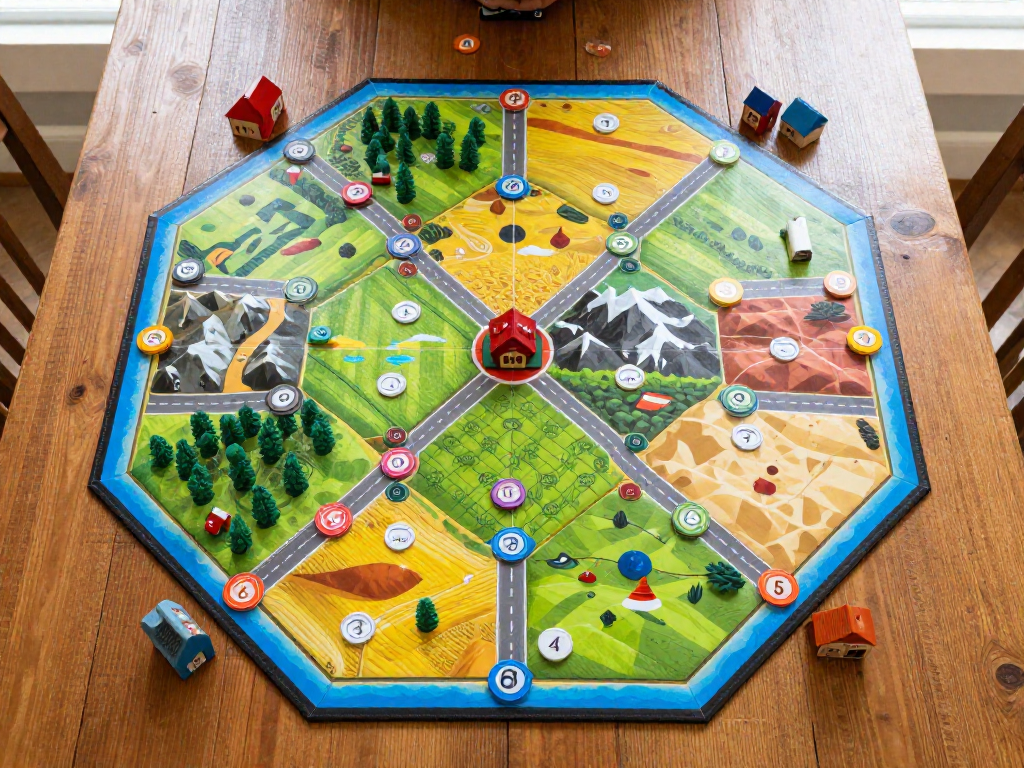
Open by acknowledging that Catan looks intimidating with its hexagons, cards, and tokens, then promise a no-jargon, first-game-friendly walkthrough that gets a family playing in about 15 minutes of reading. Set expectations: by the end you'll know how to set up the board, take a turn, trade, build, and win.
What Catan Is and What You're Trying to Do
At its heart, Catan is a game about settling an island and quietly racing your friends and family to do it best. Here's the whole goal in one sentence: be the first player to reach 10 victory points. Everything else you'll learn is just a different way to earn those points.
So where do points come from? Three main places:
- Settlements (the little house pieces) are worth 1 point each.
- Cities (the bigger pieces) are upgraded settlements worth 2 points each.
- Special cards, like the bonus for building the "Longest Road" or having the strongest army from development cards, are worth 2 points each. (A development card is just a card you buy that gives you a one-time ability or a hidden point—more on those later.)
You build all of this by collecting and trading resources—brick, wood, wheat, sheep, and ore—that the island produces each turn.
The quick stats for a family game night:
- Players: 3–4 (the base game needs at least 3; a 5–6 player expansion is sold separately)
- Ages: 10 and up, though motivated 8-year-olds do fine with a hand to hold
- Play time: about 60–90 minutes once everyone knows the rules
- Difficulty: easy to learn, with light "should I trade this?" decisions—no heavy strategy required
- Family-friendly? Yes, with no objectionable content; the only friction is the occasional groan when someone blocks your spot.
A quick peek in the box: you'll find 19 hexagonal land tiles that form the island, a stack of resource cards, development cards, number tokens that get placed on the tiles, and a set of wooden pieces (settlements, cities, and roads) in each player's color. Don't worry about sorting it all perfectly yet—we'll lay it out step by step in the next section.
Setting Up the Board Step by Step
Setup is where most first-time games stall, so we'll go slowly. Clear a table big enough for the board plus elbow room for everyone's cards. Catan plays best with 3–4 players, ages 10 and up, and a full game runs about 60–90 minutes once you know the steps below.
1. Arrange the 19 terrain hexes. These are the six-sided tiles that make up the island: forest, pasture, fields, hills, mountains, and one desert. You have two choices. The beginner layout is printed in the rulebook—just copy it tile for tile, and you'll get a balanced board with no surprises. The random layout is for later: flip all the hexes face down, shuffle, and place them in the island shape framed by the blue ocean border pieces. For your first game, use the beginner layout. It saves arguments and gives everyone a fair start.
2. Place the number tokens. These are the round chips marked 2 through 12 (there's no 7). Each non-desert hex gets one token. The number tells you which dice roll "activates" that hex to produce resources—roll a 6, and every player with a settlement touching a 6 hex collects that resource. Tokens with 6 and 8 are printed in red because they come up most often, making those hexes the richest spots. If you're doing the random layout, the rulebook gives a letter-ordered placement; for the beginner layout, the tokens are shown in position.
3. Set up the desert and the robber. The desert hex produces nothing. Place the robber—a single gray or black pawn—on the desert to start. The robber blocks a hex from producing and steals cards later, but at setup it just sits parked on the sand.
4. Sort the bank. Separate the resource cards (brick, lumber, wool, grain, ore) into five face-up stacks within everyone's reach—this is the bank. Shuffle the development cards (special action and victory-point cards) into one face-down pile beside it.
5. Pick colors and gather pieces. Each player takes one color and collects their 5 settlements (small houses), 4 cities (larger pieces), and 15 roads. Keep them in front of you.
That's the board ready. Next we'll cover placing your first settlements and roads.
Placing Your First Settlements (The Most Important Choice)
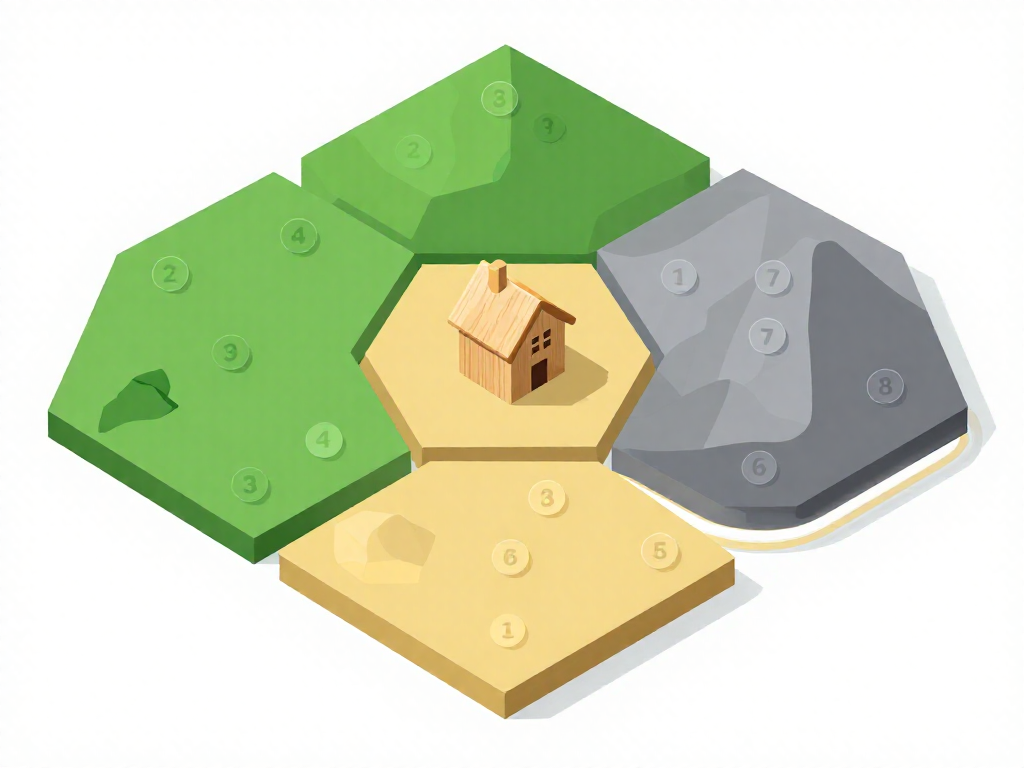
Your opening placement shapes the whole game, so slow down here. In Catan, a settlement is a small house piece you place on a corner (where three hexes meet), and a road is a stick you place along a hex edge. At the start, everyone places two settlements and two roads before normal play begins.
The snake-draft order. Players take turns placing their first settlement and road in seating order (say, Players 1, 2, 3, 4). Then the order reverses for the second round (4, 3, 2, 1). This back-and-forth is called a snake draft, and it's fair: whoever picked last in round one picks first in round two.
Aim for corners touching three different resources. Each corner can border up to three hexes. A corner that touches three hexes covering three different resources (like wood, brick, and wheat) is strong because it feeds you a variety of materials—and variety is what lets you build roads, settlements, and cities without getting stuck.
Your second settlement gives you free starting resources. Here's the friendly twist: when you place your second settlement, you immediately collect one resource card from each hex it touches. So use that second pick to grab resources you didn't already cover, rounding out your hand.
Point your roads toward open space. Place each road pointing toward a nearby empty corner you'd like to claim later—ideally one with good hexes. Roads are how you reach new building spots, so don't aim them into a dead end or straight at another player's settlement.
Reading the number tokens (6 and 8 are gold). Every resource hex has a round number token. Those numbers are how often that hex pays out, based on the two dice rolled each turn. 6 and 8 come up most often, so touching them means more frequent resources. The numbers 2 and 12 are the rarest, so don't rely on them. A simple beginner rule: chase corners that touch a 6 or 8 on a resource you'll actually use.
How a Turn Works, Start to Finish
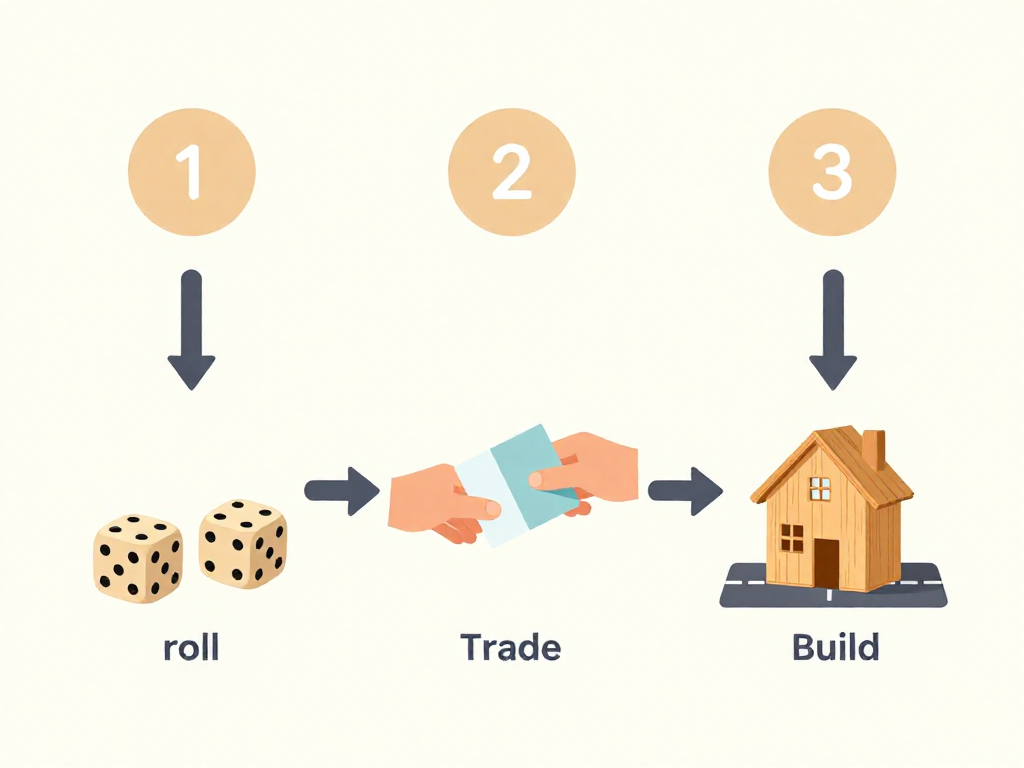
Once the board is set, every turn follows the same simple rhythm. Learn this loop once and the whole game clicks into place. Here's exactly what you do when it's your turn.
Step 1: Roll the dice and collect resources. Roll both dice and add them together. Every land tile (called a hex) has a number token on it. If your number comes up, every player who has a settlement or city touching that hex collects the matching resource—brick, wood, sheep, wheat, or ore. A settlement earns you one card from a neighboring hex; a city (an upgraded settlement) earns two. The catch: if you roll a 7, nobody collects. Instead, anyone holding more than 7 resource cards must discard half, and you move the robber (a gray pawn) onto a hex to block it and steal a card from a player there. The 7 keeps anyone from hoarding.
Step 2: Trade. Now you can swap resources to get what you're missing. You can trade with other players in any amounts you both agree to ("I'll give you two wood for one ore")—haggling is half the fun. You can also trade with the bank, which is the shared supply of cards in the box.
What 4:1 and harbor trades mean: The bank's default rate is 4:1—hand in four of the same resource to get one of any other. That's expensive, so it's a last resort. Harbors are the dock symbols printed on the coast. If you build a settlement on one, you get a better rate: a 3:1 harbor lets you trade any three matching cards for one, and a specific 2:1 harbor (like "2:1 wood") lets you trade just two of that one resource for anything. Harbors are how you turn a surplus into what you actually need.
Step 3: Build or buy. Spend your resources to build roads (extends your reach), new settlements (more resource income), or cities (double income), or to buy a development card (a face-down card that can give points or special actions). You can build as much as you can afford, in any order.
Then pass the dice. When you're done building, hand the dice to the player on your left, and their turn begins. That's it—roll, trade, build, pass, repeat until someone hits 10 victory points and wins.
Resources, Building Costs, and the Bank
Keep this section open during your first few games—it's the stuff everyone looks up mid-turn.
The Five Resources
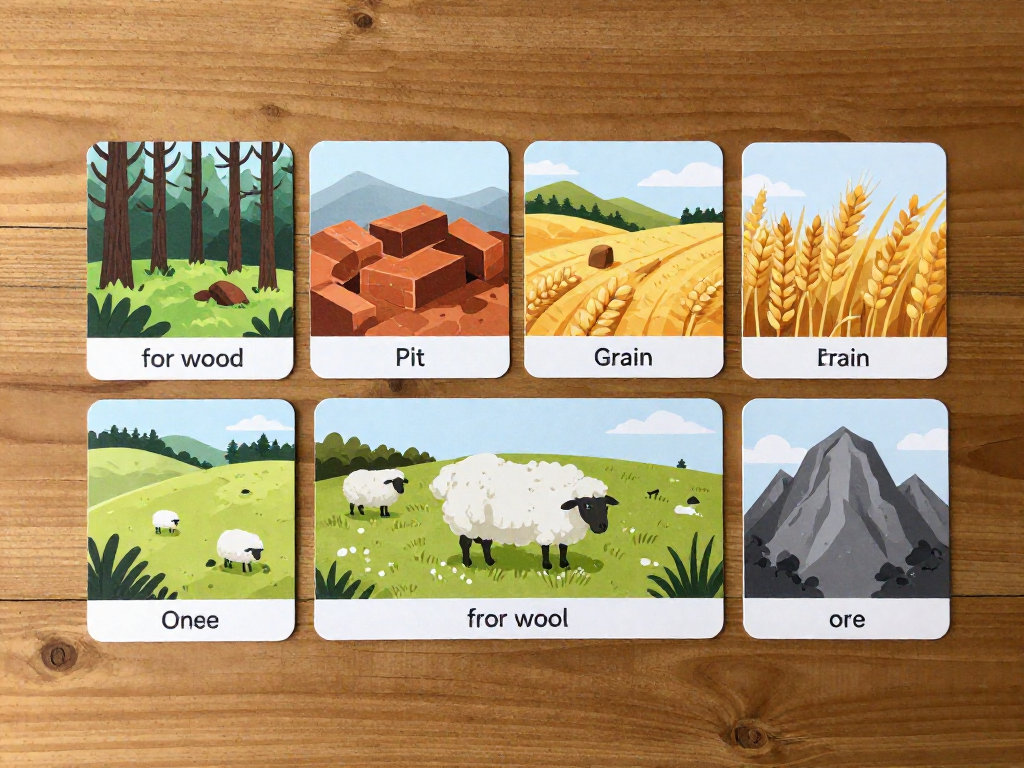
Each resource comes from a type of land tile and gets stored as a card in your hand:
- Brick (red, from hills) — roads and settlements
- Wood/Lumber (green, from forests) — roads and settlements
- Wool/Sheep (light green, from pasture) — settlements, cities, and development cards
- Grain/Wheat (gold, from fields) — settlements, cities, and development cards
- Ore (gray, from mountains) — cities and development cards
Build Cost Cheat Sheet
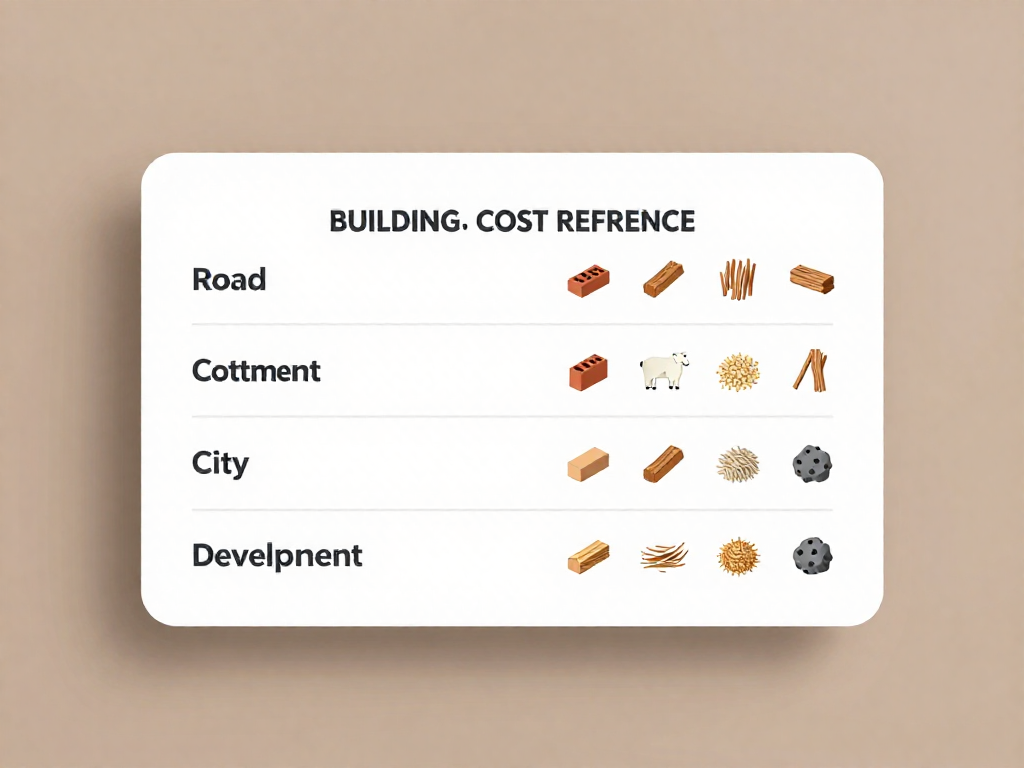
| What you build | Cost |
|---|---|
| Road | 1 brick + 1 wood |
| Settlement | 1 brick + 1 wood + 1 wool + 1 grain |
| City (upgrade) | 2 grain + 3 ore |
| Development card | 1 wool + 1 grain + 1 ore |
An easy way to remember settlements: it's "everything you need to live"—one of the four basic resources.
Settlement vs. City
A settlement is your starter building. It's worth 1 victory point and collects 1 resource card whenever its adjacent number is rolled.
A city is just an upgraded settlement on the same spot—you don't place it somewhere new. It's worth 2 victory points and collects 2 resource cards per roll instead of 1. Upgrading is how you turn early board position into faster income.
The Bank and Harbors
The bank is the central supply of resource cards. By default you can trade with it at 4:1—hand over four of one resource to get any one resource you want. That's a bad rate, so it's a last resort.
Harbors (the dock icons on the coast) lower that rate if you build a settlement on them:
- Generic harbor (3:1): trade any three matching cards for one of your choice.
- Resource harbor (2:1): trade two of one specific resource (like ore) for any one card.
Harbors only help if you can actually produce what they want, so plan settlement spots accordingly.
Rolling a 7, the Robber, and Development Cards
A few rules trip up almost every new group. Here are the ones worth getting right from your first game.
When someone rolls a 7
A 7 doesn't hand out resources—it triggers two things instead:
- Everyone discards down to 7. Any player holding 8 or more resource cards must give back half (rounded down) to the bank. Holding nine cards? Discard four. This is the game's gentle nudge to spend, not hoard.
- The roller moves the robber. The robber is the little gray or black pawn that starts on the desert.
Moving the robber and stealing
When you roll a 7 (or play a Knight card—more on that below), you move the robber onto any hex (one of the six-sided land tiles). That hex is now blocked: it produces nothing for anyone until the robber moves again, even if its number gets rolled. Then you steal one random card from any player who has a settlement or city touching that blocked hex. Aim the robber at whoever's pulling ahead.
Development cards
You buy these face-down cards from the bank (1 ore + 1 wool + 1 grain). There are three kinds:
- Knight cards — play one to move the robber and steal, just like rolling a 7. Played knights stay face-up in front of you.
- Victory Point cards — worth 1 point each; keep them hidden until you win, so they can be a surprise finish.
- Progress cards — one-time special actions (like building free roads or taking resources).
You can't play a development card the same turn you buy it (except victory points), and only one per turn.
Two bonus points to chase
- Largest Army — the first player to play 3 Knight cards earns 2 points. It can be stolen by anyone who later plays more.
- Longest Road — the first to build a connected road of 5+ segments earns 2 points, also stealable.
Both are worth a third of the way to winning, so keep an eye on them.
How to Win and Beginner Strategy Tips
The goal is simple: be the first player to reach 10 victory points. Some points are easy to track—each settlement is worth 1 and each city is worth 2. Others are hidden or shift during play, so the score can change faster than people expect.
Keep an eye on these point sources:
- Settlements and cities (1 and 2 points each)
- Longest Road: 2 points to whoever has an unbroken road of 5+ segments (it can be stolen if someone beats it)
- Largest Army: 2 points for the first player to play 3 Knight cards (also stealable)
- Victory Point development cards: hidden 1-point cards you keep secret until they push you to 10
Now the plain-English strategy. Don't over-build roads early. Roads don't earn resources, so spending your first few turns paving the board usually leaves you behind. Build roads with a clear purpose—reaching a spot you actually want to settle.
Aim for resource variety, not just quantity. Sitting on a pile of one resource feels productive, but you need a mix to build anything. Touching several different number tiles matters more than touching the highest-producing one.
Trade often—it's not optional. Catan is a trading game by design. Swapping with other players (or with the bank) fills the gaps in your hand and keeps you moving. Players who refuse to trade tend to stall.
Finally, watch what others are collecting. If someone is hoarding the resources for cities, they may be closer to winning than the visible scores suggest—so trade carefully and don't hand a leader the one card they need.
Common Setup and Rules Mistakes to Avoid
New to Catan? These are the slip-ups we made (and see most often) during a first game. Skim the list before you start—each one is a quick fix.
- Forgetting the distance rule. Every settlement must be at least two roads away from any other settlement, including your own. Two settlements can never sit on neighboring corners.
- Skipping the discard-on-7 step. When anyone rolls a 7, every player holding 8 or more resource cards must discard half (rounded down). It's easy to forget when it isn't your turn.
- Trading on another player's turn. You can only trade during the active player's turn, and only with that player or the bank—never freely between turns.
- Missing your starting resources. After everyone places their second settlement, collect one resource from each of the three tiles touching it. New players often skip this free handout.
- "Building" a city from scratch. A city isn't a separate piece you place on an empty corner—it's an upgrade of a settlement you already own. No settlement there first means no city.
Catch these early and your first game will run far more smoothly for the whole table.
FAQ
How many players do you need to play Catan?
The standard Catan base game is built for 3 to 4 players. With 3 or 4 around the table you get the right amount of competition for roads, settlements, and trades without anyone feeling crowded out. If you want to play with 2 players or with 5 to 6, you'll need a workaround or an expansion (covered below).
Can you play Catan with 2 players?
Not with the standard rules—the base game officially starts at 3. But you have two easy options. You can buy the "Catan for Two" / Rivals-style two-player versions, or use a popular house rule that adds a neutral "dummy" player whose pieces block spots but don't take turns. Honestly, Catan shines most with 3–4, so for couples or pairs we'd point you to a game designed for two from the start.
How long does a game of Catan take?
Expect about 60 to 90 minutes for a full game with 3–4 players. Your first game will run longer—closer to 2 hours—while everyone learns the setup and the trading rhythm. Once your group knows the flow, games tend to settle into the one-hour range, which makes it a comfortable single-evening game night pick.
What is the easiest way to win at Catan for beginners?
Win by being the first to reach 10 victory points (you earn points from settlements, cities, the Longest Road, the Largest Army, and certain development cards—the face-down bonus cards you buy with resources). The most beginner-friendly path: place your first settlements on spots that touch numbers like 6 and 8 (they're rolled most often) and cover a variety of resources, then upgrade settlements to cities early since each city is worth 2 points and produces double resources. Trade often and don't hoard—cards left in hand do nothing.
What happens when you roll a 7 in Catan?
A 7 triggers two things. First, any player holding more than 7 resource cards must discard half (rounded down). Second, the player who rolled moves the robber—a pawn that sits on a tile and stops it from producing—onto a new tile, then steals one random card from a player who has a settlement or city touching that tile. The 7 produces no resources for anyone, so it's the game's built-in way of shaking up a runaway leader.
Do you collect resources on your first turn in Catan?
You actually collect before the game's first dice roll. During setup each player places two settlements, and for the second settlement you place, you immediately take one resource card from each tile touching it. That's your starting hand. After that, you only gain resources when a tile's number is rolled and you have a settlement or city next to it.
See also
- Best Board Games for Family Game Night
- Beginner-Friendly Strategy Games to Try After Catan
- How to Host the Perfect Game Night at Home
- Catan Expansions Explained for New Players
Related articles
How Does Scoring Work in Board Games? Points Explained Simply
Confused about who wins and why? Learn how board game scoring works—victory points, race conditions, and tracking—in plain language for family game night.
Jun 27, 2026 · 9 min read

What Does 'Eurogame' Mean? Hobby Jargon Demystified
What is a eurogame? A plain-language guide to the eurogame style, how it differs from other board game families, and easy titles to try at home.
Jun 27, 2026 · 6 min read

Deck-Building Explained: How These Games Actually Work
New to deck-building games? Learn what they are, how the core mechanic works, and which beginner-friendly titles to try first—explained in plain language.
Jun 27, 2026 · 10 min read