How to Play Carcassonne: Tile Placement and Scoring Made Clear
How do you set up, place tiles, and score in Carcassonne?
On this page
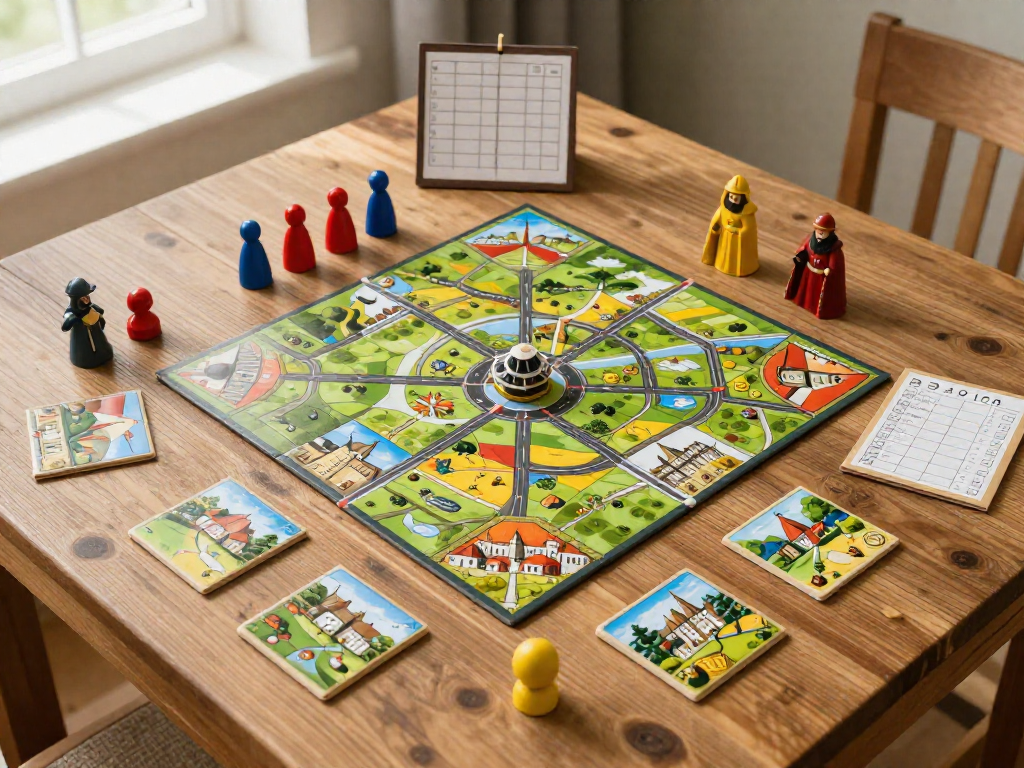
What Is Carcassonne and Why Families Love It
Carcassonne is a tile-laying game—meaning you build the board as you go by drawing and placing square tiles—where players piece together a medieval French countryside of roads, cities, and fields. There's no fixed board; the map grows organically with every turn, and everyone shares in shaping it.
Here's the quick snapshot:
- Players: 2–5
- Ages: 7 and up
- Play time: about 30–45 minutes
- Difficulty: easy to learn, light strategy
What makes it a family favorite is how gentle it is. Turns are short, the rules fit on a single page, and there's very little direct conflict—you're mostly building your own scoring opportunities rather than attacking each other. That low-pressure feel is exactly why Carcassonne is so often recommended as a first "real" board game: it's a friendly step up from party games into the hobby, with nothing in the box that's unsuitable for kids.
What's in the Box: Components at a Glance
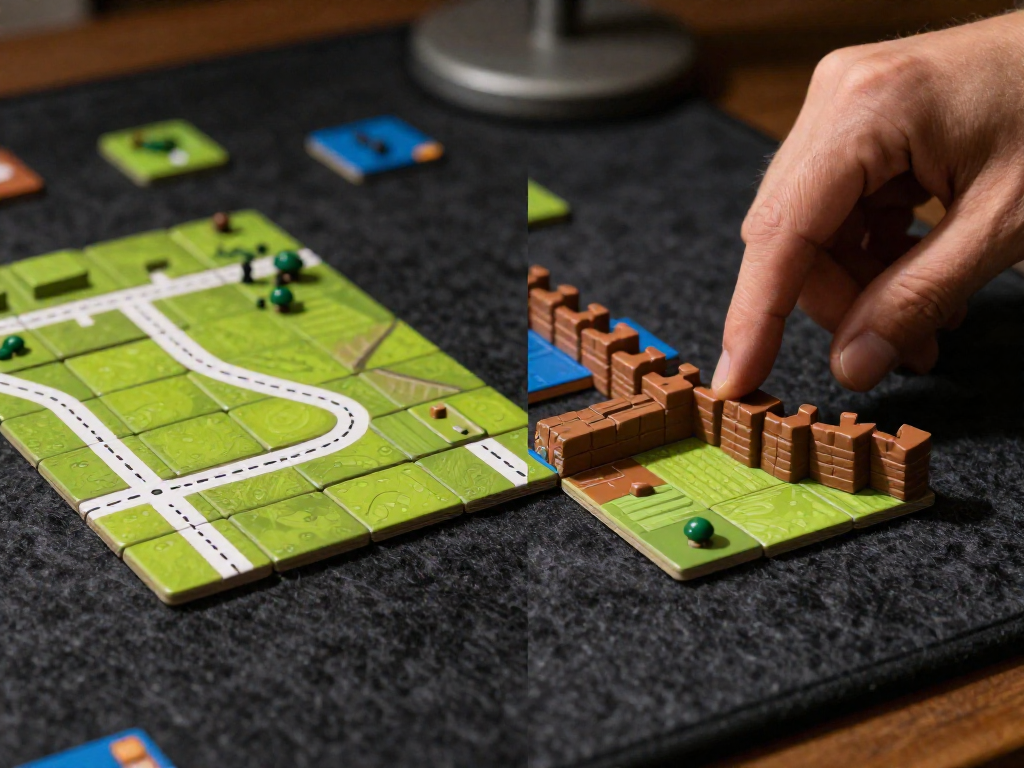
Before your first game night, take two minutes to sort the pieces. Knowing what's what makes setup quick and the rest of this guide easy to follow.
- 72 land tiles + 1 starting tile. Each square tile shows some mix of roads, cities, fields, and monasteries. The starting tile has a darker back, so flip it out first and place it in the middle of the table—everyone builds outward from there.
- Meeples (your "followers"). A meeple is just the little wooden person you place on tiles to claim them and earn points. Each player gets 7 in one color, and the game supports up to 5 colors (5 players).
- The scoreboard. A numbered track around the edge. Each player puts one meeple on it as a marker and slides it forward as they score—so you're only ever tracking one running total per person.
A quick note on expansions (extra add-on sets like Inns & Cathedrals): skip them for now. The base game is plenty for learning, and everything below assumes base-game pieces only.
How to Set Up Carcassonne
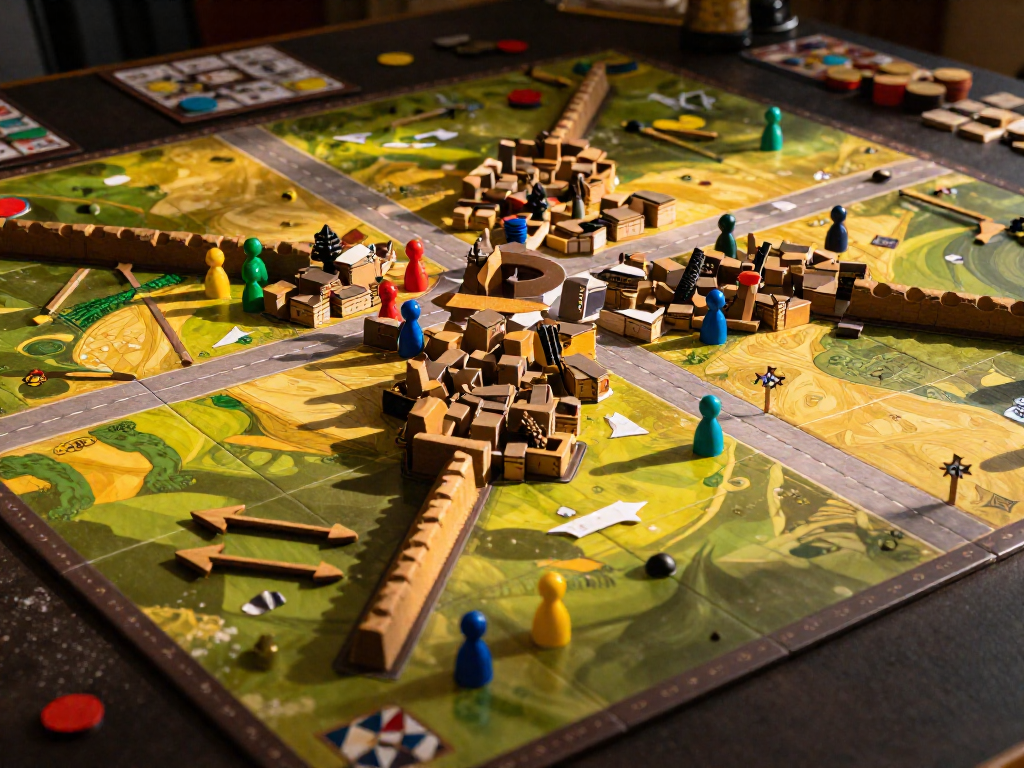
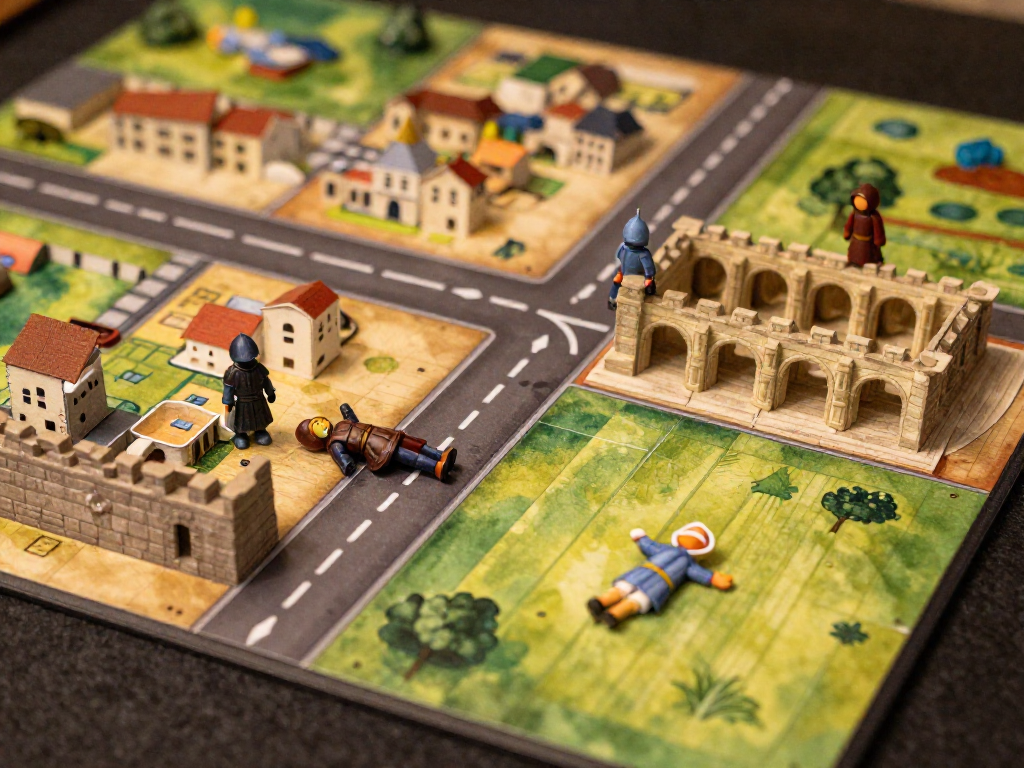
Setup takes about two minutes, and you only do it once before the fun begins. Here's exactly what to do:
- Place the starting tile in the center. This is the single tile with a dark back (older editions show a river). Set it face up in the middle of the table—it's where everyone's first moves connect.
- Shuffle the rest face down. Mix all remaining tiles into a few small draw piles, or drop them in a cloth bag so no one can peek at what's coming.
- Pick a color and grab your meeples. A meeple is just the little wooden person you'll use to claim roads, cities, and fields. Each player takes all 7 in their color, then places one on the 0 space of the scoreboard to track points.
- Choose who goes first. Any method works—a fun house rule is to let the youngest player start.
That's it. You're ready to draw your first tile and begin building.
How to Place Tiles (The Core Rule)
Tile placement is the heartbeat of Carcassonne. Master this one rule and the rest of the game clicks into place.
Here's the loop you'll repeat every turn:
- Draw one tile from the face-down pile and turn it over so everyone can see it.
- Find a legal spot for it on the table next to a tile that's already down.
- Place it so the picture on its edges lines up with its neighbors.
That third step is the whole rule, and it's worth saying plainly: the edges must match. Every tile shows some mix of three terrain types—city (the gray walled areas), road (the thin paths), and field (the green grass). When you set a new tile down, each side that touches another tile has to continue the same terrain.
- City must meet city.
- Road must meet road.
- Field must meet field.
You can rotate the tile freely before placing it—spin it 90 degrees as many times as you need to find a fit. A single tile often has two or three legal positions, so take a moment to look around the table before committing.
A quick example: say there's a tile on the table with a road running off its right edge into open space. To extend that road, your new tile must have a road on its left edge so the two connect. If your tile instead shows a city wall on that side, the road would dead-end into a wall—that's illegal, and you'll need to rotate or pick a different spot.
What if nothing fits? It's rare, but if a tile genuinely can't be placed legally anywhere, you discard it and draw a new one. No penalty—just bad luck.
The most common beginner mistake: forcing a tile into a spot where the edges don't actually match because it looks close enough. If a city edge touches a field edge, the placement is wrong, even if it seems harmless. Slow down and check all touching edges. Getting this right now keeps your scoring clean later.
Placing Meeples: Knights, Robbers, Monks, and Farmers
A meeple is your little wooden person—the playing piece you use to claim parts of the board and earn points. Here's the rhythm of every turn: you draw and place a tile first, then you may place one meeple. That's the key limit—one meeple per turn, and only on the tile you just placed. You never have to place one, and sometimes holding back is the smart move (more on that below).
Where you set your meeple decides its job. There are four roles, and they're just names for the feature you put the meeple on:
- Knight — placed on a city (the walled sections with stone edges).
- Robber (also called a thief) — placed on a road (the thin paths).
- Monk — placed on a cloister (the building tile surrounded by countryside).
- Farmer — placed lying down in a field (the open green areas). Farmers are special: they stay put until the very end of the game.
The claim rule: you cannot place a meeple on a feature someone already owns. So if a road already has a robber on it, you can't add yours to that same road—even if your new tile extends it.
Here's where it gets interesting. As tiles connect, separate features can merge into one. Imagine you own a small city and your opponent owns another small city, and a new tile joins them into a single city. Now you both have a meeple on the same feature. That's allowed when it happens through merging. When a merged feature scores, whoever has more meeples on it takes all the points. If it's a tie, every tied player scores the full amount—a great reason to merge into someone else's city when you can.
One last thing that shapes every decision: meeples come back to you only when their feature is completed and scored (farmers excepted). Place too many at once and you'll run out, stuck waiting for cities and roads to finish. Deploy patiently.
How Scoring Works: Cities, Roads, Cloisters, and Farms
Scoring is where most new players get stuck, so let's take it one feature at a time. The big idea: a "meeple" (your little wooden person) earns points for the thing it sits on. Some features score the moment they're finished; others wait until the very end of the game.
Roads are the simplest. A road is complete when it's closed at both ends—by a city, a cloister, an intersection, or a loop. When that happens, you score 1 point for each tile the road covers. A road made of four tiles is worth 4 points.
Cities are the point engines. A city is complete when its walls fully enclose it with no gaps. You score 2 points per tile, plus 2 extra points for each pennant (the little shield symbol printed on some city tiles). So a three-tile city with one pennant is worth 2 + 2 + 2 + 2 = 8 points.
Cloisters (the monastery tiles, sometimes called monasteries) score for their surroundings. A cloister is complete once all 8 tiles around it are placed, forming a filled 3x3 square. You score 1 point per tile in that square—9 points total (the cloister itself plus the 8 around it).
The golden rule: the instant a feature is completed, score it right away, then take your meeple back so you can use it again. Don't wait.
Farms (fields) are the exception—and the one rule that trips families up. A farmer you lay down stays put for the entire game; you never get that meeple back. Farms score only at the end, giving 3 points for each completed city that touches the field your farmer is in.
Quick example: You finish a 3-tile city with one pennant (8 points) that closes off a 2-tile road (2 points). You score 10 points and pull both meeples back to play again next turn.
Family note: Farm scoring can confuse younger kids—many families skip farmers entirely for a first game and add them once everyone's comfortable.
End-of-Game Scoring and Farmers Explained
The game ends the moment someone places the very last tile from the stack. After that, you tally up every "feature" still on the table that didn't get finished during play—plus the trickiest part of all, the farmers.
Scoring unfinished features
Anything you didn't complete still earns reduced points:
- Incomplete cities: 1 point per tile, plus 1 point for each pennant (the little shield symbol) inside the city.
- Incomplete roads: 1 point per tile.
- Incomplete cloisters (the monasteries your monk sits in): 1 point for the cloister tile itself, plus 1 for each surrounding tile you managed to place.
Farmers and fields
Farmers are meeples you laid down on the green grass instead of a road or city. They never come back to your hand, and they only score at the very end. Here's the rule: each farmer earns 3 points for every completed city that touches the field he's lying in. Unfinished cities don't count for farmers.
A "field" is one connected patch of grass. It's bordered—and split into separate fields—by roads, cities, and rivers. So if a road cuts across the green, the grass on each side is a different field, and a farmer only owns the patch he's actually sitting in.
Because a single field can border several big cities, farmers often quietly decide a close game. A player trailing by a few points can leap ahead if their farmer is feeding three or four finished cities. Plan your fields early—you can't add a farmer once the area fills in.
Beginner Tips and Common Mistakes to Avoid
Carcassonne clicks once you stop treating your meeples (the little wooden figures you place to claim features) as keepsakes. Here's what trips up new players—and how to play smarter on game night.
Do this:
- Keep your meeples working. You only get seven, but they come back every time a feature finishes scoring. Leaving them in your supply earns nothing, so deploy them and recover them in a steady cycle.
- Mix big and small claims. A sprawling city pays huge (2 points per tile and per shield when completed) but can stay unfinished all game. Balance those gambles with small roads and cloisters that close quickly for safe, reliable points.
- Play a little defense. You can stall an opponent's big city or road by placing tiles that make it awkward to close. You can't claim their feature, but you can keep them from cashing it in.
- Time your farmers. Farmers (meeples laid flat in fields) are stuck there until the game ends, so they pay off only at final scoring. Hold them until mid-to-late game, once you can see which cities will actually be finished.
The most common slip: forgetting to take your meeple back after a feature scores. Reclaim it immediately—an idle meeple is a wasted turn.
Difficulty: Easy to learn, light strategy. Great for ages 7+, 2–5 players, about 35 minutes—family-friendly with nothing unsuitable for young children.
FAQ
How many players can play Carcassonne?
The base game of Carcassonne is built for 2 to 5 players. It plays great as a relaxed two-player duel and still moves quickly with five. If you regularly host bigger game nights, expansions like "Inns & Cathedrals" bump the limit up to 6 players and add a few extra tiles to the mix.
How long does a game of Carcassonne take?
Plan for about 30 to 45 minutes. Two-player games can wrap up in around 30 minutes, while a full table of five may run closer to 45 since there are more placements and scoring moments to think through. It's a forgiving length for a weeknight—long enough to feel satisfying, short enough to play twice.
What happens if you can't place a tile?
If the tile you draw genuinely cannot connect to the existing map (its roads, cities, and fields don't line up anywhere), you simply discard it and draw a new one. This is rare, so don't worry about it derailing your game. Just set the unusable tile aside and keep building.
How do farmers score in Carcassonne?
Farmers are meeples (your little wooden playing pieces) that you place lying down on a field instead of standing them up on a road or city. They don't score during the game and you don't get them back—they stay put until the very end. At final scoring, each farmer earns points for every completed city that touches the field it's sitting in. Farmers are the trickiest part of the game, so beginners often skip them for the first play or two and add them once everyone is comfortable.
Can two players own the same city?
Not directly—only one tile-placement can start a city, and you can't add a meeple to a feature someone already controls. But cities can merge as the map grows: if your separate city sections connect into one, and you each have a meeple in it, you'll tie for control. When tied, every involved player scores the city's full value, so shared cities can actually be worth chasing.
Do you get your meeple back after scoring?
Yes. As soon as a road, city, or monastery is completed and scored during the game, you return that meeple to your supply to use again. The one exception is farmers placed in fields—those stay on the board until the end of the game and score only during final scoring. Managing this small pool of meeples (usually 7 per player) is a big part of the strategy.
Is Carcassonne good for kids?
Yes—Carcassonne is a strong family pick. Best for 2 to 5 players, ages 8 and up (younger kids can play on a team with an adult), about 30–45 minutes, with easy-to-learn, light-to-medium difficulty. The rules are simple, the artwork is friendly, and there's no reading or scary content. The only sticking point is farmer scoring, which confuses newcomers, so we suggest leaving farmers out for the first few games. For very young players, "My First Carcassonne" is a simpler standalone version designed for ages 4 and up.
See also
- Best board games for families with young kids
- Beginner board games that are easy to learn
- How to host a family game night at home
- Carcassonne expansions worth buying
- Gateway games like Carcassonne to try next
Related articles
How Does Scoring Work in Board Games? Points Explained Simply
Confused about who wins and why? Learn how board game scoring works—victory points, race conditions, and tracking—in plain language for family game night.
Jun 27, 2026 · 9 min read

What Does 'Eurogame' Mean? Hobby Jargon Demystified
What is a eurogame? A plain-language guide to the eurogame style, how it differs from other board game families, and easy titles to try at home.
Jun 27, 2026 · 6 min read

Deck-Building Explained: How These Games Actually Work
New to deck-building games? Learn what they are, how the core mechanic works, and which beginner-friendly titles to try first—explained in plain language.
Jun 27, 2026 · 10 min read